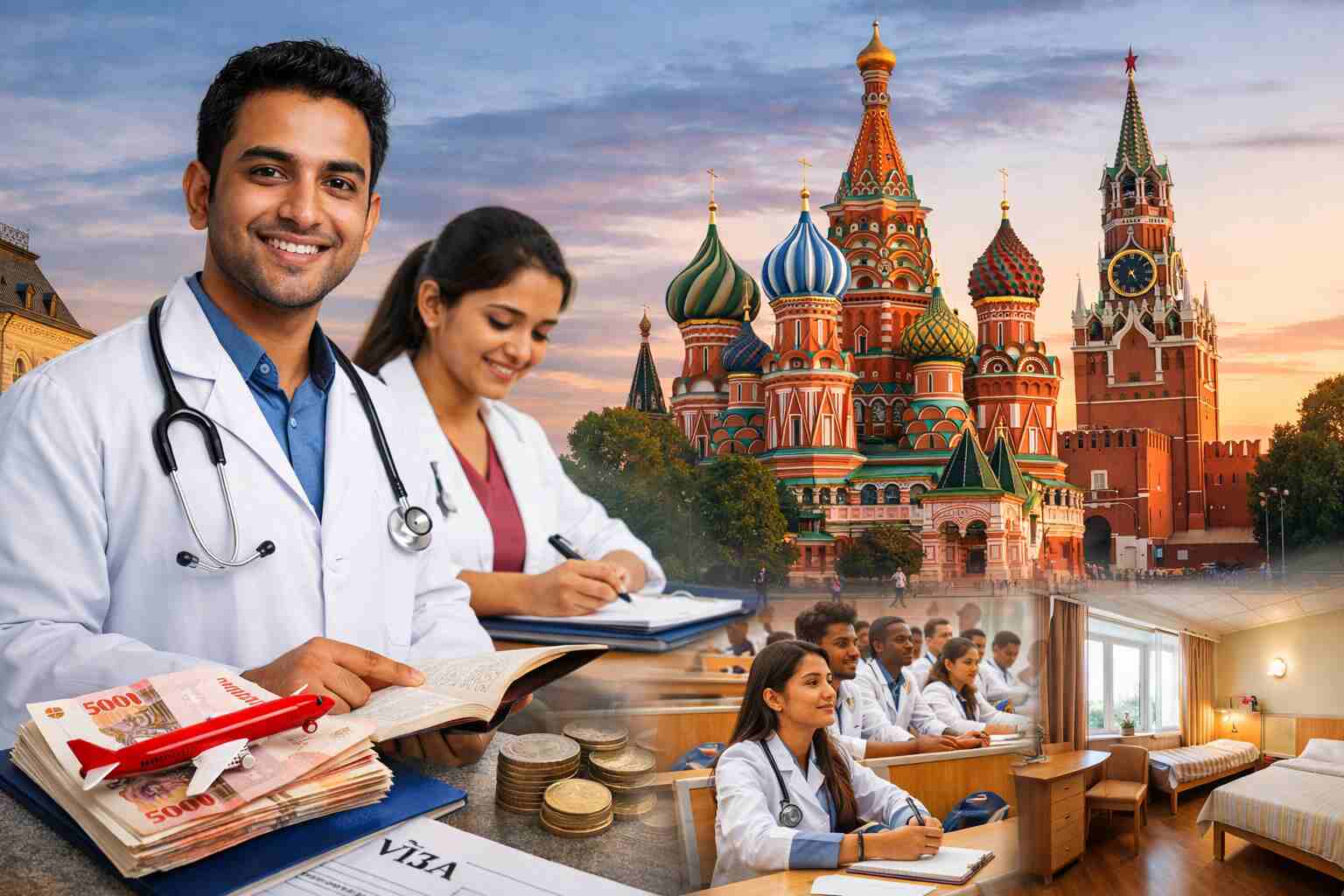

Russia has been a serious destination for Indian medical aspirants for over four decades. More than 15,000 Indian students are currently enrolled across Russian medical universities, and the numbers grow each year as parents and students recognise what Russia genuinely offers — a globally recognised, government-subsidised MBBS at roughly a third of the cost of a private medical college in India.
| Medium of Instruction | English (Full English-medium teaching) |
|---|---|
| Duration | 6 Years (5 years coursework + 1 year internship) |
| Total Cost | Approx. ₹20–30 Lakh (all inclusive) |
| Eligibility | NEET Qualified (mandatory for Indian students) |
| Exams Required | NEET, FMGE / NExT (for India practice after return) |
| Degree Awarded | MBBS (MD equivalent, NMC FMGL 2021 compliant) |
| Total Medical Universities | 70+ Government Medical Universities |
| Indian Students Enrolled | 15,000+ currently studying |
| Top University Cities | Moscow, St. Petersburg, Kazan, Novosibirsk, Volgograd |
| Visa | Russia Student Visa (issued via university invitation letter) |
| Cost of Living | ₹15,000 – ₹20,000 per month (approx.) |
Indian students aiming to study MBBS in Russia must qualify NEET and obtain a student visa through a university-issued invitation letter. No donation, no capitation fee, and no IELTS or TOEFL is required for admission — making the process significantly more straightforward than many other destinations.
The Russian medical education system has a 75+ year track record, producing around 35,000 doctors annually. Large multispeciality teaching hospitals are attached to each major institution, ensuring real bedside clinical exposure from year two onwards. The standard 6-year MBBS program fully satisfies India's NMC FMGL 2021 regulations, keeping graduates eligible to sit the FMGE/NExT and practice in India. For NEET-qualified students who missed a government seat and don't wish to pay ₹80 lakh–₹1.5 crore at an Indian private college, Russia remains one of the strongest, most credible alternatives available today.
Tuition runs ₹3.5–6 lakh per year. The total 6-year cost typically lands between ₹25–40 lakh — a fraction of what an Indian private medical college charges. The published fee is the only fee, disclosed in writing before any payment is made.
Government and approved Russian universities do not accept donations or capitation fees. Anyone asking for 'extra' payments is operating as an unauthorised sub-agent — always a red flag, never a feature.
Russia's standard 6-year MBBS (5 years coursework + 12 months internship at the same university, in English medium) fully satisfies NMC's 54-month + 12-month rule, keeping graduates eligible for FMGE/NExT.
Russian MBBS degrees from WHO/WDOMS-listed universities are accepted for licensing exams in India (FMGE/NExT), the United States (USMLE), the United Kingdom (PLAB), Australia, and the Middle East.
Most Russian medical universities are attached to large, busy multi-speciality teaching hospitals. Patient interaction begins in year two and intensifies through years 4–6, ensuring real bedside experience.
All NMC-eligible universities offer the entire MBBS in English. Basic Russian is taught as a side module — useful during clinical rotations but never a barrier to academic progress.
Major universities have active Indian student associations, Indian messes, festival celebrations (Diwali, Holi, Eid), and strong senior–junior support networks, so students are never navigating year one alone.
A qualifying NEET score is sufficient for admission. No additional university entrance test, no IELTS or TOEFL required at most universities — making the application process simple and direct.
Regular connections from Delhi and Mumbai to Moscow, with onward domestic links to all major Russian university cities, making travel convenient for students and parents.
From counselling and university shortlisting through visa, forex, ticketing, hostel allocation, and post-departure support — a single accountable team, not a relay of agents.
Choosing the wrong university — or worse, the wrong consultant — is the single most expensive mistake a family can make on the MBBS-abroad journey. The fee saved by a cheaper option is meaningless if the degree doesn't satisfy NMC FMGL 2021 rules and you can't sit FMGE/NExT in India. CHD's counselling is built around preventing exactly this.
Your NEET score, Class 12 marks, budget bracket, family medical context, and long-term career goals such as India practice, USMLE pathway, PLAB pathway, or Middle East opportunities are carefully reviewed.
Get a focused shortlist of 3–5 NMC-eligible Russian universities based on your budget, FMGE pass-rate history, climate preference, city size, Indian community presence, and language support.
If your profile is better suited for destinations like Uzbekistan or Georgia instead of Russia, we will guide you honestly and recommend the best option for your future.
Parents can directly ask questions related to hostel safety, food, climate adjustment, emergency communication, and what happens if the student wishes to return home mid-course.
Receive a transparent fee structure covering tuition, hostel, insurance, visa, and travel expenses for the complete 6-year MBBS program without hidden charges.
Take your time to discuss with family and even connect with existing CHD students studying at the university before making your final decision.

The Russian medical education system follows a structured 6-year MBBS program at all NMC-eligible universities. The curriculum is designed to provide strong theoretical knowledge, practical clinical exposure, and international medical recognition for Indian students planning to practice globally.
During the first two years, students study subjects like Anatomy, Physiology, Biochemistry, Histology, Medical Biology, and basic Russian language training. The third and fourth years focus on para-clinical subjects such as Pathology, Pharmacology, Microbiology, Forensic Medicine, and Public Health.
The final two years include advanced clinical rotations and internship training in departments like General Medicine, Surgery, Obstetrics & Gynaecology, Paediatrics, Psychiatry, Orthopaedics, ENT, Ophthalmology, Dermatology, Emergency Medicine, and Anaesthesiology.
Universities recommended by CHD comply with NMC FMGL Regulations 2021, are listed in the WHO World Directory of Medical Schools (WDOMS), and are eligible for international licensing pathways such as USMLE (USA) and PLAB (UK).
Russia is one of the most preferred destinations for Indian students pursuing medical and healthcare education abroad. While MBBS remains the most popular program, Russian universities also offer Dentistry, Pharmacy, Nursing, and Postgraduate medical specialisations. These programs are available at internationally recognised universities with modern infrastructure, experienced faculty, and affordable tuition fees compared to many Western countries.
Find the popular medical and healthcare programs in Russia for Indian students along with average course duration from the table below.
| Course | Course Duration | Key Highlights |
|---|---|---|
| MBBS / MD (General Medicine) | 6 Years | English-medium, NMC-eligible, most preferred by Indian students |
| BDS (Dentistry) | 5 Years | Also known as Stomatology in Russia, available at major medical universities |
| Pharmacy (B.Pharma / Pharm.D) | 5 – 6 Years | Offered at universities like Kazan Federal and Volgograd SMU |
| BSc Nursing | 4 Years | Available at select Russian medical universities |
| MD/MS Clinical Specialisations | 2 – 4 Years | Popular for Indian MBBS graduates pursuing PG abroad |
Although Russia is highly recommended for MBBS, students interested in Dentistry, Pharmacy, Nursing, or allied healthcare programs may also explore destinations such as the UK, Germany, or Canada depending on their long-term career goals and return on investment.
Russia is home to several internationally recognised medical universities that attract thousands of Indian students every year. Universities recommended by CHD comply with NMC FMGL Regulations 2021 requirements, are recognised by Russia’s Ministry of Health, listed in the WHO World Directory of Medical Schools (WDOMS), and offer English-medium medical programs with mandatory internship training.
These universities have established infrastructure, experienced faculty, Indian student communities, hostel facilities, and a strong history of Indian graduates successfully clearing FMGE and pursuing medical careers in India and abroad.
| University Name | University Known For | Location | Course Duration | Medium of Instruction |
|---|---|---|---|---|
| Bashkir State Medical University | Large Indian student community, strong hostel and Indian mess facilities | Ufa | 6 Years | English |
| Kazan Federal University | Globally ranked university with advanced research and modern campus | Kazan | 6 Years | English |
| Crimea Federal University | Warm climate, affordable living cost, popular among Indian students | Simferopol | 6 Years | English |
| Tver State Medical University | Affordable tuition fees and structured academic environment | Tver | 6 Years | English |
| Volgograd State Medical University | Strong international medical education reputation | Volgograd | 6 Years | English |
| Perm State Medical University | Strong FMGE performance and disciplined academic culture | Perm | 6 Years | English |
| Orenburg State Medical University | Affordable fee structure with smaller student batches | Orenburg | 6 Years | English |
| Mari State University | Personalised teaching approach and smaller campus environment | Yoshkar-Ola | 6 Years | English |
Yes — provided the university complies with NMC FMGL Regulations 2021, including a minimum 54-month academic program plus a 12-month internship at the same university, English-medium instruction, and listing in the WHO World Directory of Medical Schools (WDOMS). Indian students must also clear FMGE or NExT after returning to India for medical registration.
FMGE performance varies by university, academic discipline, and student preparation. Universities such as Bashkir State Medical University, Perm State Medical University, Kazan Federal University, and Volgograd State Medical University have established records of Indian graduates successfully clearing FMGE. Choosing the right university with proper academic support is extremely important.